
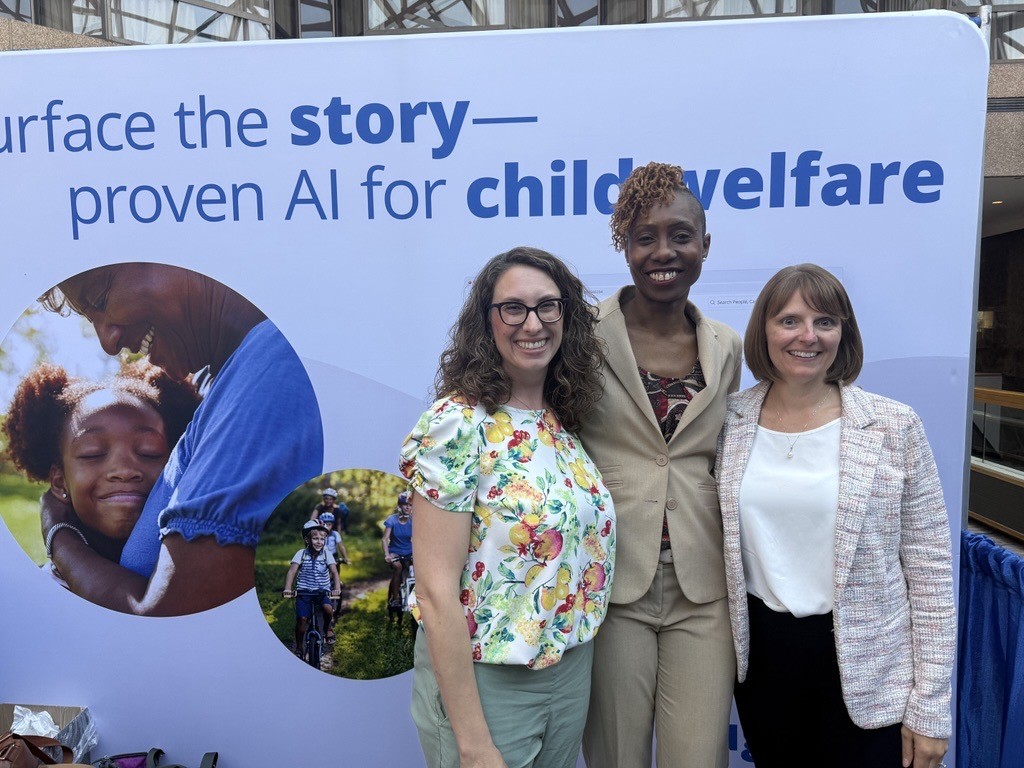
When I first sat down with the teams at Augintel and Chapin Hall, I was honest with them - I'm a social worker, not a data scientist or a researcher. But I had a question I couldn't shake, and I needed partners who could help me answer it.
The Question Nobody Had Asked
For years, I have been working on racial equity practice at the Illinois Department of Children and Family Services (DCFS). We could see disparities clearly in our outcome data — in who gets reported, removed, and reunified, and how long families stay involved in the child welfare system. We knew that bias was affecting how families were experiencing our system. What we couldn't see was where that disparity was entering. What was driving it at the practice level? What was happening in the day-to-day work that we weren't measuring? I had a theory. I believed part of the answer was in our case notes — in the words our workers were writing to describe families. But I couldn't prove it. I couldn't read 16,000 case notes. No one could. And that's when everything changed.
My team from the Office of Racial Equity Practice at DCFS had been examining decision points across the system — investigations, placements, and permanency outcomes. But the written record? What workers wrote in those files had never been systematically examined. Not because we didn't think it mattered, but because we didn't have a way to look at it at scale accordingly.
I first came across Augintel – a tool that looks at the language used in case notes – through an information session on the equity tracer. It stopped me in my tracks. When I met Tracy Rohrdanz, Director of Customer Impact at Augintel, and a former caseworker herself, I told her we had high-level data, but I was missing the story behind it. I could see the numbers. I couldn't see what was driving them. She understood immediately, and together with Kristine Creavey from Chapin Hall, we built a partnership to find out.
How We Turned Case Notes into Something We Could Actually Use
Every case note holds an important part of a family's story that we've never been able to read at scale.
When a caseworker writes a note after a home visit, they're capturing something real — what they saw, heard, and felt about a family that day. That language lives in the file, but nobody has ever been able to read it systematically across thousands of cases. The volume prevented that from ever happening. So, all that information — the context, the story, the day-to-day reality of what families are experiencing — has always been invisible at the system level. Augintel brings it to light.
Augintel reads what workers write in case notes, dictations, and assessments the way a very thorough researcher would, except it can do it across the entire caseload at once. It looks for patterns in how families are being described and flags language that's judgmental rather than factual labels that carry no behavioral context, and observations that came from a police report rather than the worker's own eyes. And then it organizes all of that into something digestible and can easily be sorted by case status, by organization, by region or by case type.
For me, the most important question Augintel helped me answer was: how prevalent is this language across our organization, and where and for whom does it show up most? That's not a data science question. That's a practice question. And for the first time, I had an answer.
Why the Language in Case Notes Matters More Than We Think
Before we get into what we found, I want to make something clear because it's the reason this work matters. The words in a case note don't stay in that note. They travel. The language a worker uses to describe a family today follows that family to the next worker who picks up the file, to the service provider assessing the need for services, to the foster parent reading the placement summary, to the judge making a decision about a child's future. Every description, every label, every characterization becomes part of the permanent record that shapes how that family is seen and treated, sometimes for years.
This is why it matters whether a note says, "Dad is aggressive" or "Dad became agitated during the visit after learning his daughter's placement was being changed without his knowledge." Both might describe the same moment. But only one of them gives the next person a chance to help.
A Note About Bias
It's easy to hear "bias in case notes" and think it means workers with bad intentions. That's not what we found. What we found is that bias often enters through language that feels neutral or even professional in the moment, but that does real harm when it follows a family for years. Looking at the data gives us the opportunity to learn not to point fingers. If we can all learn from each other and have these conversations, we can better serve families equitably.
What We Found — and What It Meant
We analyzed over 16,000 unique family records containing case notes written by DCFS and Child Welfare Contributing Agency caseworkers across Illinois. What we looked for was straightforward: how much biased language was present in our written record, where was it showing up, and for which cases and organizations was it most prevalent? The information that Tracy and Kristine identified from the data confirmed what I suspected and highlighted other things that I had not anticipated.
Three bias themes kept surfacing: negative language describing people; negative language describing housing conditions; and what the team called authorship challenges, language absorbed directly from police reports or referral sources into our official records without any critical filter.
Augintel was able to count and categorize this language across all 16,000 records by case status, organization, and region. For the first time, we could see patterns. Not a hunch. Not an impression from reading a few files. Actual evidence of how often this language appears, and where.
Below are fictional training examples that that illustrate what we found. Two workers document the same child on the same day. Read them back-to-back and ask yourself: which worker would you want showing up at your door?
Fictional case note — April 24, 2004:
"During today's visit, Jasmine was aggressive with peers. She continues to be aggressive, noncompliant , and defiant in group settings. Staff addressed her behavior. Jasmine has never been compliant with any services. Jasmine has always given DCFS a hard time and is defiant with everyone. Jasmine has a mental health history."
Now read the second note — written the same day, about the same child.
Fictional case note — April 24, 2004:
"During today's visit, Jasmine became upset after learning her mother is incarcerated and that she would not be able to have a visit this weekend. During an interaction with peers, she raised her voice and pushed another youth. Staff stepped in to maintain safety and supported her in taking space from the group.
Jasmine appeared overwhelmed and had difficulty calming at first, but was able to settle with staff support. Jasmine has had some difficulty engaging consistently with services and can struggle at times in her interactions with staff and others. She has a history of mental health needs."
The first note tells you what Jasmine is. The second tells you what Jasmine is going through. One is a verdict. The other is a roadmap. Every worker who opens the first file after this note will arrive expecting a problem. Every worker who opens the second will arrive with context and a true opportunity to help her.
Take this one example and multiply it by 16,000 families. Some files are full of notes like the first one. Some are full of notes like the second. Until Augintel, no one had ever been able to ask: how much of this language exists across our system, where is it concentrated, and which families are receiving which kind of documentation? That's the question we finally got to answer.
What I Learned About Partnership as a Practice Leader
I want to be clear: I did not do this alone. The reason this project worked is that each of us who worked on this initiative brought something the others didn't have, and we were all honest about our limitations from the start.
The Illinois DCFS Office of Racial Equity Practice understood the importance of the words used to describe families and wanted to learn more about defining the question and translating findings into practice change. Augintel provides a platform that gives DCFS access to insights from the written record, scaled across all cases. Chapin Hall brings the research expertise to support and measure change across the department, allowing true integration into DCFS priorities rather than a one-time data exercise.
What I'd Tell Every Agency Leader
I'm a social worker. I came to this work to serve families, not to analyze data. But what I've learned is that you don't have to be a data analyst to lead this kind of work. You have to know what question you're trying to answer and then find the right sources and partners to help you answer it. If you're an agency leader reading this, I'd ask you to look around your own organization. Who has the equity lens? Who has the data capacity? Who has the research relationships? Those people probably already exist. What may be missing is the technology that connects them and the leadership that gives them permission to ask hard questions.
The words your workers are writing right now to describe the families you serve will follow those families for years. They will shape every decision that comes after. And unless you examine them, you will never know what story they're telling. I know that's a hard thing to sit with. It was hard for me too. But you cannot fix what you cannot see. And for the first time, we have a tool that provides us with clarity.
What we have done in Illinois is replicable. The partnership model works. The technology is available. What it requires is a leader who is willing to ask the hard question. I asked it, and am glad I did. I would encourage every one of you to ask it too.


.png)


.jpg)

