
Illinois DCFS Uses Augintel to Uncover Bias
The Office of Racial Equity Practice at DCFS could track investigations, placements, and permanency outcomes.
Learn how Maryland DHS uses AI to analyze the case notes their workforce was already writing →


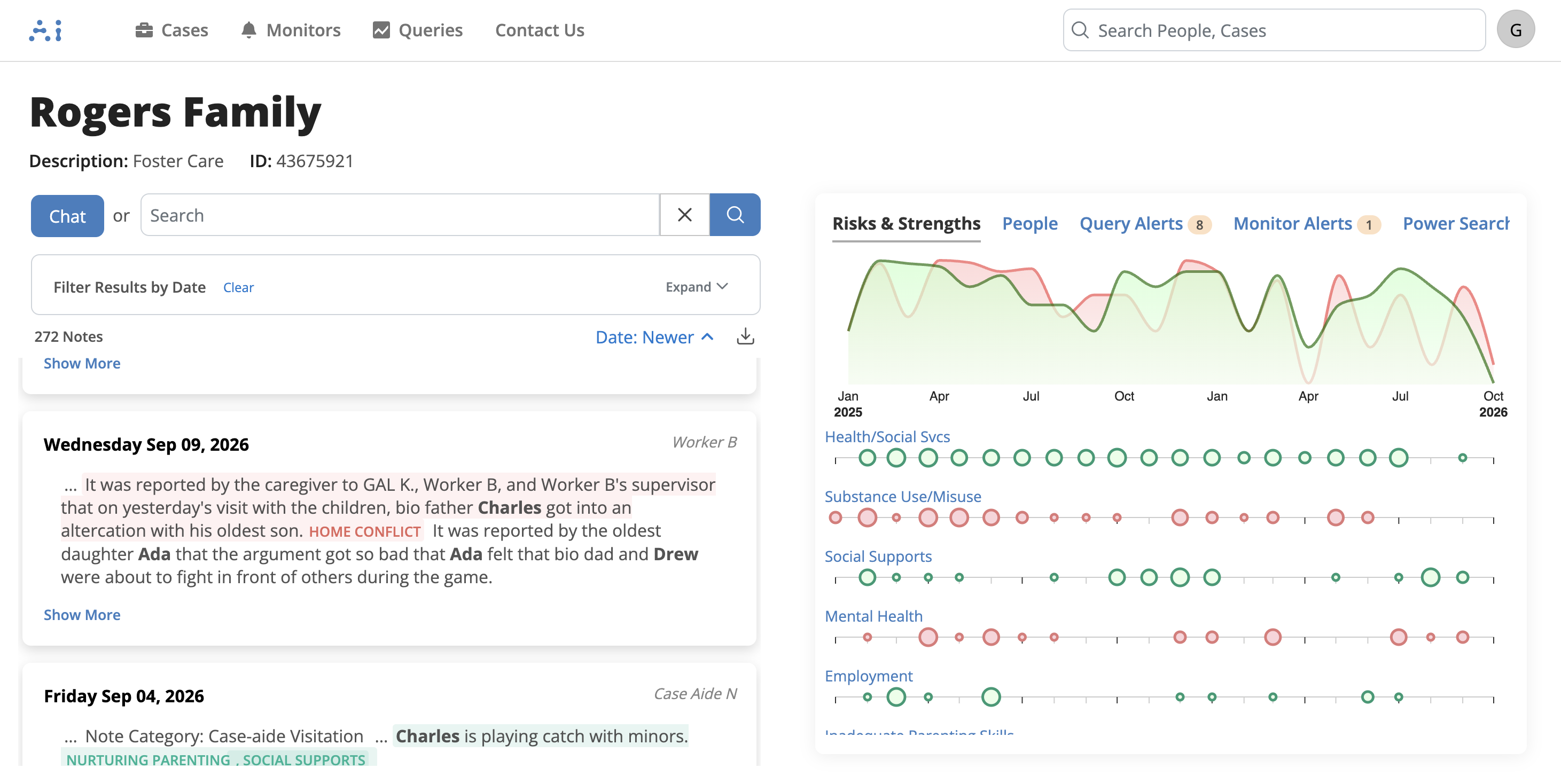

Child welfare case notes hold the fullest record of what children and families go through, but few agencies can read them at scale. The Maryland Department of Human Services worked with Augintel to change that. In 60 days, they analyzed nearly 2,000 case files and turned years of case notes into practice insights for all 24 of Maryland's jurisdictions.
Dr. Alger Studstill, Executive Director of Maryland's Social Services Administration, described the project in a recent webinar. This post covers what Maryland found, how the review worked and what other agencies can learn from it.
Maryland wanted to understand its complex, high-acuity youth. Between 2020 and 2025, these young people had experienced a hotel stay, a hospital overstay, an office stay or an out-of-state placement. A hospital overstay means a young person was medically cleared for discharge but had no next placement ready.
Structured data could show whether tasks were done on time. It couldn't show a young person's full history.
"Case notes are the lifeline of any good case management practice," Dr. Studstill said. Their case note review with Augintel covered 1,965 complex-youth cases, each case record running to hundreds of pages. "No human would've been able to do that in the short amount of time that we were looking for," he said.
Maryland ran two 60-day case note analysis projects at once. The first built a profile of complex youth. The second reviewed five years of serious physical injury and fatality cases, looking for early red flags.
Augintel's team, made up of former child welfare staff, met with Maryland's placement and fatality review teams and the Secretary's office. Together they agreed on the questions that mattered and who would use the answers.
The teams then defined about 10 topics in writing, including needs, barriers, strengths, and formal and informal resources. Barriers alone were broken into about a dozen categories, each with examples of what counted and what didn't. AI then read every note against those same definitions.
Standard reports often miss good work, and the case notes made it visible. Across the 1,965 complex-youth cases:
Each jurisdiction received its own profile. It covered case counts, placement history, barriers and bright spots, plus a spotlight on one young person told through quotes from the case notes. In Baltimore City, worker advocacy was documented in 100% of cases and communication with families and stakeholders in 93%. Gaps were framed as opportunities rather than compliance failures. "This was some of the most valuable information that I've seen over the course of my career," Dr. Studstill said.
Some findings went beyond what Maryland set out to learn, like the kin connections. "That wasn't a part of our research question… I wouldn't have known some of this had we not tried to understand what the profile for Maryland's complex youth was," he said.
The results also confirmed that training was working. Maryland passed kinship laws in 2024 and has focused on centering youth voice. The reviewed cases went back to 2020, which showed staff valued youth voice well before the new laws, they just had no way of showing it at scale.
The case notes also showed where youth struggle. On average, each young person had 8 identified needs and 13 barriers. 31% had juvenile justice involvement, and 26% had complex medical needs.
Where those needs showed up mattered as much as how often. Maryland knew it needed more adolescent substance use treatment options, but the data showed which jurisdictions needed it most. With the state facing a budget crisis, that matters. "Instead of trying to roll something out statewide, if only four jurisdictions see this particular barrier when it comes to substance treatment, how can we targeting our intervention to address those needs?" Dr. Studstill asked.
The data held surprises too. The top seven jurisdictions for youth involved in both child welfare and juvenile justice were rural, not the metro areas that make the news. Maryland is now looking at bringing those jurisdictions together with the Department of Juvenile Services to explore a crossover model. A gap in mental health access has also prompted a new idea: a real-time directory of available services, so families aren't stuck on long waitlists.
The findings are shaping Maryland's prevention plan and its conversations with providers. "If you don't have the data to know what the needs of young people are, then we continue down this cycle of just building and continuing programming when the programming really might not be what's needed for today's young people," Dr. Studstill said.
The second project allowed Maryland to see and count instances of safe sleep assessments in serious injury and fatality cases reviewed. They could also see documentation of safe drug storage and offers or referrals for concrete supports such as childcare. Documented practice like this rarely appears in a media story or legislative audit. Now Maryland has evidence to answer the legislature while it keeps looking for ways to improve.
Data security is a top concern for any agency leader exploring AI. Maryland handled it through a formal contract and a data sharing agreement reviewed by both sides' legal counsel. The review used only data Maryland already held for children in its custody. No private details, such as birth parents' addresses or dates of birth, were shared. Under the agreement, Augintel deletes the data when the contract ends.
The project made no predictions and no decisions about families. It looked back at past cases purely to learn. "AI doesn't make decisions. AI has to have a human that's reconciling, that's reviewing," Dr. Studstill said.
On bias, Maryland asked the same questions it would ask about any child, rather than sorting cases by race or group. The same approach can also surface biased language in case notes. In another state, Augintel has flagged phrases like "filthy home."
Dr. Studstill offered this advice to other states:
For Dr. Studstill, the real payoff is time. "AI can help with some of the administrative burden, but then it frees up the brain power of a human to now sit and analyze and plan," he said. "I didn't have to have people reading 1,900 cases, but now I can give them a 25, 30-page report and say, let's start to think through what are the service interventions that are needed."
He sees more uses ahead. AI could summarize a family's case history before a worker opens a new case, or help a new worker catch up after turnover without reading years of notes. But it won't replace judgment. It doesn't decide whether a child is safe, and it doesn't take the place of a worker supporting a parent who has lost hope. As Maryland's administration puts it, the goal is to be "data-driven, heart-led."
Watch the full recording to hear Dr. Studstill describe the project in his own words. To find out what a case note review could show your agency, contact Augintel and get connected with a practice expert.


Nearly 6 years ago the CCWIS Final Rule was published, and with it, a lot of excitement about how technology could support practice in child welfare.

Becoming more data-driven requires more than analyzing the structured data already captured in agency systems.

At APHSA ISM in Spokane this year, the conversations around AI in child welfare are dramatically changing.




In child welfare, there’s no substitute for the judgment, experience, and dedication of caseworkers. We believe AI is a support tool – not a replacement – for that expertise. Our AI uses natural language processing to analyze case notes, identify patterns, and surface warning signs. All to help caseworkers better serve children and families.
© 2026 Augmented Intelligence Technologies, Inc.