Learn how Maryland DHS uses AI to analyze the case notes their workforce was already writing →


Augintel Discover

Answers in 60 Days

Your agency’s case notes aren’t just documentation. They’re a source of intelligence​ for your entire agency.

Confident older woman with short hair, wearing a light-colored blazer and pearl necklace, standing with arms crossed over abstract pastel shapes and an orange curved line.

Augintel is proven AI for child welfare agencies​

From Case-by-Case Review to Agency-Wide Learning

In 60 days, Augintel’s data team analyzes and structures case note data, surfaces what's locked inside, and prepares reports for leadership, legislators, and funders — with almost no lift from IT.​

Three donut charts summarizing data of 617 reviewed cases: Cohort distribution shows 43% in Cohort 1 (youth with 1+ unlicensed placements) and 57% in Cohort 2 (youth with 0 unlicensed placements); Gender distribution shows 62% female, 37% male, and 1% transgender; Race distribution shows 86% Black, 10% White, 3% multiple races, and 1% unknown. Below are three circular stats with numbers: Average number of placements is 12, average number of workers is 11, and average number of months in care is 77.

Your Case Notes Tell a Bigger Story

Augintel makes narrative data searchable and countable.​ Our practice analysts and machine learning experts work side by side to analyze every case note and identify the patterns and outliers your leadership can act on.

Answer Your Agency’s Toughest Questions

Finally get a more complete picture of agency performance and populations, such as:

  • High-Risk Youth Review
  • Kinship Care Review
  • Placement Instability Review
  • Dually involved with Juvenile Justice Review
  • Critical Incident Review
  • Custom Analysis
A professional older woman with short gray hair stands on stone steps outside a classical building, reviewing documents in a folder while dressed in a navy suit and carrying a brown shoulder bag.
Man with dark hair wearing a green shirt and red lanyard sitting at a white desk working on a laptop with a disposable coffee cup nearby in a modern office setting.

No Heavy Lift from IT

IT provides a one-time, secure export of data you already produce​. Everything else is on us.​

There is no ongoing feed, no new workflow, and it doesn’t integrate with CCWIS / SACWIS.

Deliverables in 60 Days

Analysis is meaningless unless it improves practice. In 60 days, you’ll receive:
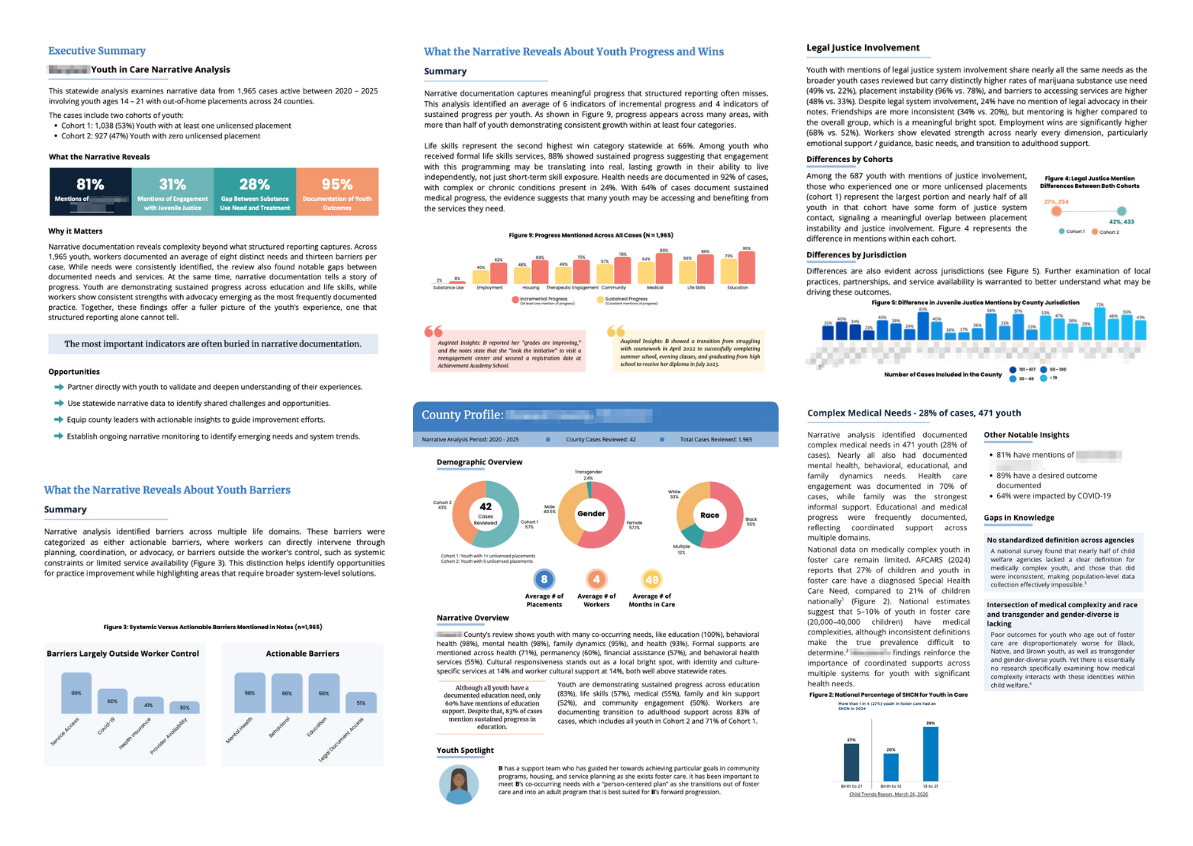
  • A live presentation of findings
  • All notes turned into structured data for further internal analysis
  • An executive summary and report for legislatures
  • A proof-of-concept for using narrative to improve practice
Three infographic panels showing a youth in care narrative analysis with data from 1,965 cases, including charts and key insights. The first panel highlights 81% youth served, 31% case history shared, and 28% participations, summarizing importance of narrative documentation, opportunities like using statewide narrative data, and barriers mostly related to worker control. The middle panel outlines narrative themes about youth progress and wins, with a diagram linking themes such as strengths and challenges across emotional and social domains. The third panel presents county-specific profile data for 42 youth, demographic overview, narrative overview including behavioral and mental health stats, youth spotlight, legal justice involvement statistics including disparities and differences by jurisdiction, complex medical needs at 28%, and other insights on gaps in knowledge and interagency collaborations.

“Most of our social work case reporting can be found only in case notes. To be able to quickly scan and access case notes across multiple domains such as health, education, and family engagement has improved our review, training, and supervision practices.”

How Illinois DCFS Uses AI to Uncover Bias in Child Welfare Case Notes

Illinois DCFS knew that bias was affecting families. With Augintel they analyzed how families were being described, and flagged language that's judgmental rather than factual.

How Maryland DHS Turned Thousands of Child Welfare Case Notes Into Practice Insights

In this Q&A, Dr. Alger Studstill of Maryland DHS shares how they use AI to analyze the case notes their workforce are already writing.

Using Unstructured Data to Assess Adherence to Practice

In this webcast, APHSA, the Illinois Department of Children and Family Services (DCFS) and Chapin Hall discuss how they analyze case notes across an agency to fill the data gaps.

Analyze case notes, identify patterns, and improve practice.

More than 80% of child welfare data is unstructured narrative text. With Augintel, you can quickly search case notes to better understand families.